Leitão da Bairrada is one of the best-known dishes of Bairrada region. In 2011 it was also a candidate for one of the 7 Wonders of Gastronomy in Portugal and took its place in TOP 21 (1).
It's one of the many meat dishes that Portuguese just love. For leitão da Bairrada is used young, about one and half month old piglet (1). The excellent weight is 9 kg (2).
Although it is known that the Romans already appreciated piglet, not many gastronomic books show this relation. The fact is that since 17th century more pigs were raised in Bairrada's lands and this was the major impulse to lead to extensive commercialization (1). The oldest known document that refers to this dish is “Cadernos de Refeitório, manuscrito conventual” from the year 1743, probably from the Monastery of Lorvão. Nevertheless, due to the lack of documentation, all counties in the Bairrada region claim the origin of leitão da Bairrada as theirs, especially Anadia, Agueda and Aveiro (3). The marketing of leitão began according to a document from the early 20th century in Covões as an order of Sociedade das Águas de Luso but who made leitão da Bairrada really famous was Álvario Pedro from Aguim (Anadia county). He started with his business in 1943 and in 1949 opened the first restaurant that sells leitão da Bairrada to the general public, in Sernadelo (Aveiro county). After this many restaurants followed his lead and nowadays it is possible to get leitão da Bairrada everywhere around Portugal. However, in the municipalities of Aveiro, Anadia, Agueda, Oliveira do Bairro, Cantanhede, but also in the northern municipality of Coimbra the tradition of leitão da Bairrada is more confirmed (1).
It's one of the many meat dishes that Portuguese just love. For leitão da Bairrada is used young, about one and half month old piglet (1). The excellent weight is 9 kg (2).
Although it is known that the Romans already appreciated piglet, not many gastronomic books show this relation. The fact is that since 17th century more pigs were raised in Bairrada's lands and this was the major impulse to lead to extensive commercialization (1). The oldest known document that refers to this dish is “Cadernos de Refeitório, manuscrito conventual” from the year 1743, probably from the Monastery of Lorvão. Nevertheless, due to the lack of documentation, all counties in the Bairrada region claim the origin of leitão da Bairrada as theirs, especially Anadia, Agueda and Aveiro (3). The marketing of leitão began according to a document from the early 20th century in Covões as an order of Sociedade das Águas de Luso but who made leitão da Bairrada really famous was Álvario Pedro from Aguim (Anadia county). He started with his business in 1943 and in 1949 opened the first restaurant that sells leitão da Bairrada to the general public, in Sernadelo (Aveiro county). After this many restaurants followed his lead and nowadays it is possible to get leitão da Bairrada everywhere around Portugal. However, in the municipalities of Aveiro, Anadia, Agueda, Oliveira do Bairro, Cantanhede, but also in the northern municipality of Coimbra the tradition of leitão da Bairrada is more confirmed (1).
I think that following article describes process of making leitão da Bairrada better than I could ever do.
LEITÃO À BAIRRADA
«ROAST OF THE GODS»
Previously things were a little different. Since the killings, the methods of preparing and roasting the pig. The wood stoves are no longer the same. "Today we are very well prepared." But the flavor that a "good hand" gives meat, that has remained over the years and was quickly enrolled in Portuguese traditions.
"Formerly it was roasted on a spit of laurel. Now no longer!" José Mendes has little more than forty years and twenty working together to this restaurant ovens. Witnessed many changes, "always better" and there remains "because he was born in the cradle of stick and not gold." His profession is "not the best" why "is that today no one wants to learn because it becomes too routine. No Sundays or holidays or Easter or Christmas. Hospitality industry in every day are working." The hardships of the profession, as "the heat that passes in front of the ovens in Summer" takes D. Margaret stated that anyone who does this work "has to be a vocation. Not often appears a roaster with hand. It has to be for pleasure."
Zé, as you fondly call D. And Margaret D. Etelvina, the owners of the restaurant Typical Bairrada, "has hand" to roast piglets. "He knows how to see the oven temperature just by the color of the bricks, turn it over and over, bites it and then leave these piglets tostadinhos" explains D. Marguerite.
According to her the secret of good roast suckling pig is the quality of the product. A good pig, a good flavor and a good oven, "and the hand of those who do" details are extremely important in the final product.
Regarding the controversy surrounding the origin of the famous Piglet Bairrada, José Mendes just says: "Ask anyone. Where is the pig? Always been the Mealhada!"
Until it gets to the plate
Piglets arrive at the premises of the restaurant one day before slaughter. Get to the next day and then are prepared. There are compartments intended for their brief stay. In this authorized slaughterhouse, animals are killed and cleaned by an employee specifically hired for this task. This process is, in this case, accompanied by a veterinarian who, after analyzing the animals already cleaned, they put a stamp of quality assurance. Thus, all piglets that pass for seasoning and roasting zone - the zone of furnaces - are of excellent quality to bake and sell.
Before putting the piglet stop baking, the oven is heated for "about an hour", with eucalyptus bark. "Previously aquecíamos ovens with vines (remains of pruning vines). Now there's no women that catch. Matches are coming in and buried," said José Mendes.
Already in front of the ovens piglets are threaded on a spit and the interior is barred with "sauce made with lots of garlic, white pepper, salt and lard." ,
The pig is "cooked" to go bake. And what is this "bake" the pig? Nothing more than sew the neck and belly of the animal, with a large needle and thick thread, where it was placed the sauce.
In each furnace are baked simultaneously, four or five piglets. These are just introduced into the furnace when the bricks "are white" which means that the temperature in the oven is ideal for receiving the small piglets. The meat roasting takes about an hour and a half or two hours. Who decides if the pig is "no point" is the grill. He is who knows all the tricks so that the meat is juicy and the skin crispy. After all it is "a good roaster" that makes the success of a restaurant like this. Piglet withdrawn out of the furnace excess sauce is drained by one of the holes made by the spit (mouth and tail).
Selling leitão da Bairrada
Until you get to the table Piglet went through a lengthy process. The fact that this is not unconnected with the current cost of the piglet. A live animal, with about 9 kg (ideal weight), which after cooking is about 5 kg, costing "around ten thousand escudos. After roast their value per kg reaches near the five thousand escudos, "that's why a normal pig, who do not have neither head nor feet, costs around 20 000 escudos," explains Margaret D.. 'If consumed here in the restaurant is accompanied by fries and mixed salad. "" In However, "atalha D. Etelvina," to preserve its original taste should not have many side dishes because they alter it flavor. Some say it's better just with bread. "" The tradition of the orange is old and people in the villages were proud to show their roast suckling well and garnished with an orange in his mouth and olives in the eye, but the very orange changes the flavor of the meat. "
Other successes of the restaurant are the "sandwich pig" because that "there is no monitoring that will steal the taste of meat." (2)
Previously things were a little different. Since the killings, the methods of preparing and roasting the pig. The wood stoves are no longer the same. "Today we are very well prepared." But the flavor that a "good hand" gives meat, that has remained over the years and was quickly enrolled in Portuguese traditions.
"Formerly it was roasted on a spit of laurel. Now no longer!" José Mendes has little more than forty years and twenty working together to this restaurant ovens. Witnessed many changes, "always better" and there remains "because he was born in the cradle of stick and not gold." His profession is "not the best" why "is that today no one wants to learn because it becomes too routine. No Sundays or holidays or Easter or Christmas. Hospitality industry in every day are working." The hardships of the profession, as "the heat that passes in front of the ovens in Summer" takes D. Margaret stated that anyone who does this work "has to be a vocation. Not often appears a roaster with hand. It has to be for pleasure."
Zé, as you fondly call D. And Margaret D. Etelvina, the owners of the restaurant Typical Bairrada, "has hand" to roast piglets. "He knows how to see the oven temperature just by the color of the bricks, turn it over and over, bites it and then leave these piglets tostadinhos" explains D. Marguerite.
According to her the secret of good roast suckling pig is the quality of the product. A good pig, a good flavor and a good oven, "and the hand of those who do" details are extremely important in the final product.
Regarding the controversy surrounding the origin of the famous Piglet Bairrada, José Mendes just says: "Ask anyone. Where is the pig? Always been the Mealhada!"
Until it gets to the plate
Piglets arrive at the premises of the restaurant one day before slaughter. Get to the next day and then are prepared. There are compartments intended for their brief stay. In this authorized slaughterhouse, animals are killed and cleaned by an employee specifically hired for this task. This process is, in this case, accompanied by a veterinarian who, after analyzing the animals already cleaned, they put a stamp of quality assurance. Thus, all piglets that pass for seasoning and roasting zone - the zone of furnaces - are of excellent quality to bake and sell.
Before putting the piglet stop baking, the oven is heated for "about an hour", with eucalyptus bark. "Previously aquecíamos ovens with vines (remains of pruning vines). Now there's no women that catch. Matches are coming in and buried," said José Mendes.
Already in front of the ovens piglets are threaded on a spit and the interior is barred with "sauce made with lots of garlic, white pepper, salt and lard." ,
The pig is "cooked" to go bake. And what is this "bake" the pig? Nothing more than sew the neck and belly of the animal, with a large needle and thick thread, where it was placed the sauce.
In each furnace are baked simultaneously, four or five piglets. These are just introduced into the furnace when the bricks "are white" which means that the temperature in the oven is ideal for receiving the small piglets. The meat roasting takes about an hour and a half or two hours. Who decides if the pig is "no point" is the grill. He is who knows all the tricks so that the meat is juicy and the skin crispy. After all it is "a good roaster" that makes the success of a restaurant like this. Piglet withdrawn out of the furnace excess sauce is drained by one of the holes made by the spit (mouth and tail).
Selling leitão da Bairrada
Other successes of the restaurant are the "sandwich pig" because that "there is no monitoring that will steal the taste of meat." (2)
---
Leitão da Bairrada é um dos pratos mais conhecidos da região da Bairrada. Em 2011, este prato foi candidato a uma das 7 Maravilhas da Gastronomia de Portugal, sendo um dos 21 pratos finalistas (1).
É um dos muitos pratos de carne que o Portugueses adoram. Para Leitão da Bairrada jovem, cerca de um mês e meia idade leitão é usado (1). O peso excelente é 9 kg (2).Apesar de se saber que os romanos já apreciavam leitão, não são muitos os livros de gastronomia que o referem assado. Facto é que desde o século XVII que a criação de suínos se tornou excedentária em terras da Bairrada e esse facto constituiu um grande impulso que o levou à sua comercialização (1). O documento mais antigo que se refere a este prato é "Cadernos de Refeitório, Manuscrito conventual" a partir do ano 1743, provavelmente do Mosteiro do Lorvão. Todavia, devido a esta falta de documentação mais exacta, todos os concelhos da região da Bairrada reivindicam a sua origem, especialmente Anadia, Agueda e Aveiro (3). A comercialização de leitão terá começado em Covões (Cantanhede), segundo um documento do início do século XX, de uma encomenda feita pela Sociedade das Águas de Luso, mas o seu grande arranque terá sido levado a cabo por Álvaro Pedro (Anadia condado). Ele começou com o seu negócio em 1943 e em 1949 abriu o primeiro restaurante que comercializa para o grande público leitão assado à Bairrada, em Sernadelo (Aveiro condado). Após este restaurantes muitos seguiram seu exemplo e hoje é possível obter Leitão da Bairrada em todos os lugares por todo o Portugal. No entanto, nos concelhos da Aveiro, Anadia, Águeda, do Oliveira do Bairro, Cantanhede, mas também no do norte do concelho de Coimbra a tradição do leitão da Bairrada é mais confirmada (1).
Acho que o artigo a seguir descreve processo de tomada de leitão da Bairrada melhor do que eu jamais
poderia fazer.
LEITÃO À BAIRRADA
«ASSADO DOS DEUSES»
Antigamente as coisas eram um pouco diferentes. Desde as matanças, aos modos de preparar e assar o leitão. Os fornos a lenha também já não são os mesmos. "Hoje são muito bem preparados". Mas o sabor que uma "boa mão" dá à carne, esse manteve-se com os anos e rapidamente ficou inscrito nas tradições portuguesas.
"Antigamente era assado em espeto de loureiro. Agora já não!" José Mendes tem pouco mais de quarenta anos e há vinte que trabalha junto aos fornos deste restaurante. Assistiu a muitas mudanças, "sempre para melhor" e por ali continua "porque nasceu em berço de pau e não de ouro". A sua profissão "não é das melhores" por isso "é que hoje ninguém quer aprender porque se torna muito rotineiro. Não há domingos nem feriados, nem Páscoa ou Natal. Na indústria hoteleira todos os dias são de trabalho". As agruras da profissão, como "o calor que se passa no Verão em frente aos fornos" leva D. Margarida a afirmar que quem faz este trabalho "tem que ser por vocação. Não é com frequência que aparece um assador com mão. Tem que ser por gosto".
O Zé, como lhe chamam carinhosamente D. Margarida e D. Etelvina, as proprietárias do Restaurante Típico da Bairrada, "tem mão" para assar leitões. "Ele sabe ver a temperatura do forno só pela cor das tijoleiras, volta-o vezes sem conta, pica-o e depois saem estes leitões tostadinhos", esclarece D. Margarida.
Segundo ela o segredo de bem assar o leitão está na qualidade do produto. Um bom leitão, um bom tempero e um bom forno, "e a mão de quem o faz" são pormenores de extrema importância no produto final.
Em relação à polémica que envolve a origem do famoso Leitão à Bairrada, José Mendes apenas diz: "Pergunte a quem quiser. De onde é o leitão? Sempre foi da Mealhada!"
Até chegar ao prato
Os leitões chegam às instalações do restaurante um dia antes do abate. Ficam para o dia seguinte e só então são preparados. Há compartimentos destinados à sua breve estadia. Neste matadouro autorizado, os animais são mortos e limpos por um funcionário especialmente contratado para essa tarefa. Este processo é, neste caso, acompanhado por uma veterinária que, depois de analisar os animais já limpos, lhes coloca um carimbo de garantia de qualidade. Assim, todos os leitões que passam para a zona de tempero e assadura - a zona dos fornos - são de óptima qualidade para assar e comercializar.
Antes de colocar o leitão parar assar, o forno é aquecido durante "mais ou menos uma hora", com cascas de eucalipto. "Antigamente aquecíamos os fornos com vides (restos da poda das videiras). Agora já não há mulheres que as apanhem. São partidas na vinha e enterradas", comenta José Mendes.
Já em frente aos fornos os leitões são enfiados num espeto e o seu interior é barrado com "o molho feito com muito alho, pimenta branca, banha e sal". ,
O leitão é "cozido" para ir assar. E o que é este "cozer" o leitão? Nada mais do que costurar o pescoço e barriga do animal, com uma grande agulha e linha grossa, onde foi colocado o molho.
Em cada forno são assados, ao mesmo tempo, quatro ou cinco leitões. Estes apenas são introduzidos no forno quando as tijoleiras "estão brancas" o que significa que o forno está na temperatura ideal para receber os pequenos leitões. A carne demora a assar cerca de uma hora e meia ou duas horas. Quem decide se o leitão está "no ponto" é o assador. Ele é que conhece os truques todos para que a carne fique suculenta e a pele estaladiça. Afinal é "um bom assador" que faz o sucesso de um restaurante deste género. Retirado o leitão para fora do forno o excesso do molho é escorrido por um dos orifícios feitos pelo espeto (boca e rabo).
Vender leitão assado
Até chegar à mesa o leitão passou por um processo demorado. A este facto não está alheio o actual custo do leitão. Um animal vivo, com cerca de 9 kg (o peso ideal), que depois de assado fica com cerca de 5 kg, custa "à volta de dez contos. Depois de assado o seu valor / kg atinge valores próximos dos cinco mil escudos, "por isso um leitão normal, onde não contamos nem a cabeça, nem as patas, custa à volta de 20 contos", esclarece D. Margarida. "Se for consumido aqui no restaurante é acompanhado por batata frita e salada mista". "No entanto", atalha D. Etelvina, "para que preserve o seu sabor original não deve ter muitos acompanhamentos pois estes alteram-lhe o sabor. Há quem diga que é melhor só com pão!". "A tradição da laranja é antiga e as pessoas nas aldeias tinham orgulho de mostrarem o seu leitão bem assado e enfeitado com uma laranja na boca e azeitonas nos olhos, mas a própria laranja altera o sabor da carne".
Outro dos sucessos do restaurante são as "sandes de leitão" porque assim "não há acompanhamento que venha roubar o paladar à carne". (2)
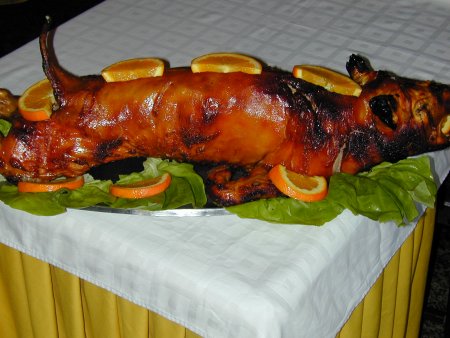 |
| Leitão da Bairrada (4) |
For 12 persons / para 12 pessoas
- 1 piglet / 1 leitão (3kg depois de limpo)
- 100 g of lard / 100 gr de banha
- 100 g of bacon / 100 gr de toucinho
- 10 cloves of garlic / 10 dentes de alho
- 2 soupspoons of coarse salt / 2 colheres (sopa) de sal grosso
- 2 soupspoons of pepper / 2 colheres (sopa) de pimenta do reino
- 3 bay leaves / 3 folhas de louro
- olive oil / azeite de oliva
- dry white wine / Vinho branco seco
- chopped parsley / salsinha picada
- salt / sal
- 2½ kg of young potatoes cooked with peel / 2½ kg de batatas novas pré-cozidas com casca
Mash in a mortar, in order: garlic, salt, pepper, parsley, bacon, lard and bay until thoroughly full. Add olive oil until a piglet is not very thick.
With a thick needle pierce piglet's back and shoulders. Pass the spice in piglet, greasing well both inside and outside. Sew the belly.
Bake slowly in a wood burning oven basting from time to time, with white wine.
Halfway through the cooking place the potatoes, peeled, on broiler.
When it's baked, remove the accumulated sauce.
---
Amasse em um almofariz, por ordem: alho, sal, pimenta, salsinha, toucinho, banha e louro até estarem totalmente desfeitos. Adicione azeite de oliva até obter uma papa não muito grossa.
Com uma agulha grossa fure as costas e as espáduas do leitão. Passe o tempero no leitão, untando bem por dentro e por fora. Costure a barriga.
Asse, lentamente, em forno à lenha regando, de vez em quando, com vinho branco.
Na metade do cozimento coloque as batatas, sem casca, na assadeira.
Quando estiver assado, retire o molho acumulado no ventre.


