Showing posts with label prato principal. Show all posts

Wednesday, February 20, 2013

Leitão da Bairrada

Leitão da Bairrada is one of the best-known dishes of Bairrada region. In 2011 it was also a candidate for one of the 7 Wonders of Gastronomy in Portugal and took its place in TOP 21 (1).

It's one of the many meat dishes that Portuguese just love. For leitão da Bairrada is used young, about one and half month old piglet (1). The excellent weight is 9 kg (2).
Although it is known that the Romans already appreciated piglet, not many gastronomic books show this relation. The fact is that since 17th century more pigs were raised in Bairrada's lands and this was the major impulse to lead to extensive commercialization (1). The oldest known document that refers to this dish is “Cadernos de Refeitório, manuscrito conventual” from the year 1743, probably from the Monastery of Lorvão. Nevertheless, due to the lack of documentation, all counties in the Bairrada region claim the origin of leitão da Bairrada as theirs, especially Anadia, Agueda and Aveiro (3). The marketing of leitão began according to a document from the early 20th century in Covões as an order of Sociedade das Águas de Luso but who made leitão da Bairrada really famous was Álvario Pedro from Aguim (Anadia county). He started with his business in 1943 and in 1949 opened the first restaurant that sells leitão da Bairrada to the general public, in Sernadelo (Aveiro county). After this many restaurants followed his lead and nowadays it is possible to get leitão da Bairrada everywhere around Portugal. However, in the municipalities of Aveiro, Anadia, Agueda, Oliveira do Bairro, Cantanhede, but also in the northern municipality of Coimbra the tradition of leitão da Bairrada is more confirmed (1).

I think that following article describes process of making leitão da Bairrada better than I could ever do.

LEITÃO À BAIRRADA
«ROAST OF THE GODS»

Previously things were a little different. Since the killings, the methods of preparing and roasting the pig. The wood stoves are no longer the same. "Today we are very well prepared." But the flavor that a "good hand" gives meat, that has remained over the years and was quickly enrolled in Portuguese traditions.
"Formerly it was roasted on a spit of laurel. Now no longer!" José Mendes has little more than forty years and twenty working together to this restaurant ovens. Witnessed many changes, "always better" and there remains "because he was born in the cradle of stick and not gold." His profession is "not the best" why "is that today no one wants to learn because it becomes too routine. No Sundays or holidays or Easter or Christmas. Hospitality industry in every day are working." The hardships of the profession, as "the heat that passes in front of the ovens in Summer" takes D. Margaret stated that anyone who does this work "has to be a vocation. Not often appears a roaster with hand. It has to be for pleasure."
Zé, as you fondly call D. And Margaret D. Etelvina, the owners of the restaurant Typical Bairrada, "has hand" to roast piglets. "He knows how to see the oven temperature just by the color of the bricks, turn it over and over, bites it and then leave these piglets tostadinhos" explains D. Marguerite.
According to her the secret of good roast suckling pig is the quality of the product. A good pig, a good flavor and a good oven, "and the hand of those who do" details are extremely important in the final product.
Regarding the controversy surrounding the origin of the famous Piglet Bairrada, José Mendes just says: "Ask anyone. Where is the pig? Always been the Mealhada!"

Until it gets to the plate
Piglets arrive at the premises of the restaurant one day before slaughter. Get to the next day and then are prepared. There are compartments intended for their brief stay. In this authorized slaughterhouse, animals are killed and cleaned by an employee specifically hired for this task. This process is, in this case, accompanied by a veterinarian who, after analyzing the animals already cleaned, they put a stamp of quality assurance. Thus, all piglets that pass for seasoning and roasting zone - the zone of furnaces - are of excellent quality to bake and sell.
Before putting the piglet stop baking, the oven is heated for "about an hour", with eucalyptus bark. "Previously aquecíamos ovens with vines (remains of pruning vines). Now there's no women that catch. Matches are coming in and buried," said José Mendes.
Already in front of the ovens piglets are threaded on a spit and the interior is barred with "sauce made with lots of garlic, white pepper, salt and lard." ,
The pig is "cooked" to go bake. And what is this "bake" the pig? Nothing more than sew the neck and belly of the animal, with a large needle and thick thread, where it was placed the sauce.
In each furnace are baked simultaneously, four or five piglets. These are just introduced into the furnace when the bricks "are white" which means that the temperature in the oven is ideal for receiving the small piglets. The meat roasting takes about an hour and a half or two hours. Who decides if the pig is "no point" is the grill. He is who knows all the tricks so that the meat is juicy and the skin crispy. After all it is "a good roaster" that makes the success of a restaurant like this. Piglet withdrawn out of the furnace excess sauce is drained by one of the holes made by the spit (mouth and tail).

Selling leitão da Bairrada
Until you get to the table Piglet went through a lengthy process. The fact that this is not unconnected with the current cost of the piglet. A live animal, with about 9 kg (ideal weight), which after cooking is about 5 kg, costing "around ten thousand escudos. After roast their value per kg reaches ​​near the five thousand escudos, "that's why a normal pig, who do not have neither head nor feet, costs around 20 000 escudos," explains Margaret D.. 'If consumed here in the restaurant is accompanied by fries and mixed salad. "" In However, "atalha D. Etelvina," to preserve its original taste should not have many side dishes because they alter it flavor. Some say it's better just with bread. "" The tradition of the orange is old and people in the villages were proud to show their roast suckling well and garnished with an orange in his mouth and olives in the eye, but the very orange changes the flavor of the meat. "
Other successes of the restaurant are the "sandwich pig" because that "there is no monitoring that will steal the taste of meat." (2)


---
Leitão da Bairrada é um dos pratos mais conhecidos da região da Bairrada. Em 2011, este prato foi candidato a uma das 7 Maravilhas da Gastronomia de Portugal, sendo um dos 21 pratos finalistas (1).
É um dos muitos pratos de carne que o Portugueses adoram. Para Leitão da Bairrada jovem, cerca de um mês e meia idade leitão é usado (1). O peso excelente é 9 kg (2).Apesar de se saber que os romanos já apreciavam leitão, não são muitos os livros de gastronomia que o referem assado. Facto é que desde o século XVII que a criação de suínos se tornou excedentária em terras da Bairrada e esse facto constituiu um grande impulso que o levou à sua comercialização (1). O documento mais antigo que se refere a este prato é "Cadernos de Refeitório, Manuscrito conventual" a partir do ano 1743, provavelmente do Mosteiro do Lorvão. Todavia, devido a esta falta de documentação mais exacta, todos os concelhos da região da Bairrada reivindicam a sua origem, especialmente Anadia, Agueda e Aveiro (3). A comercialização de leitão terá começado em Covões (Cantanhede), segundo um documento do início do século XX, de uma encomenda feita pela Sociedade das Águas de Luso, mas o seu grande arranque terá sido levado a cabo por Álvaro Pedro (Anadia condado). Ele começou com o seu negócio em 1943 e em 1949 abriu o primeiro restaurante que comercializa para o grande público leitão assado à Bairrada, em Sernadelo (Aveiro condado). Após este restaurantes muitos seguiram seu exemplo e hoje é possível obter Leitão da Bairrada em todos os lugares por todo o Portugal. No entanto, nos concelhos da Aveiro, Anadia, Águeda, do Oliveira do Bairro, Cantanhede, mas também no do norte do concelho de Coimbra a tradição do leitão da Bairrada é mais confirmada (1).

Acho que o artigo a seguir descreve processo de tomada de leitão da Bairrada melhor do que eu jamais 
poderia fazer.

LEITÃO À BAIRRADA
«ASSADO DOS DEUSES» 

Antigamente as coisas eram um pouco diferentes. Desde as matanças, aos modos de preparar e assar o leitão. Os fornos a lenha também já não são os mesmos. "Hoje são muito bem preparados". Mas o sabor que uma "boa mão" dá à carne, esse manteve-se com os anos e rapidamente ficou inscrito nas tradições portuguesas.

"Antigamente era assado em espeto de loureiro. Agora já não!" José Mendes tem pouco mais de quarenta anos e há vinte que trabalha junto aos fornos deste restaurante. Assistiu a muitas mudanças, "sempre para melhor" e por ali continua "porque nasceu em berço de pau e não de ouro". A sua profissão "não é das melhores" por isso "é que hoje ninguém quer aprender porque se torna muito rotineiro. Não há domingos nem feriados, nem Páscoa ou Natal. Na indústria hoteleira todos os dias são de trabalho". As agruras da profissão, como "o calor que se passa no Verão em frente aos fornos" leva D. Margarida a afirmar que quem faz este trabalho "tem que ser por vocação. Não é com frequência que aparece um assador com mão. Tem que ser por gosto".
O Zé, como lhe chamam carinhosamente D. Margarida e D. Etelvina, as proprietárias do Restaurante Típico da Bairrada, "tem mão" para assar leitões. "Ele sabe ver a temperatura do forno só pela cor das tijoleiras, volta-o vezes sem conta, pica-o e depois saem estes leitões tostadinhos", esclarece D. Margarida.
Segundo ela o segredo de bem assar o leitão está na qualidade do produto. Um bom leitão, um bom tempero e um bom forno, "e a mão de quem o faz" são pormenores de extrema importância no produto final.
Em relação à polémica que envolve a origem do famoso Leitão à Bairrada, José Mendes apenas diz: "Pergunte a quem quiser. De onde é o leitão? Sempre foi da Mealhada!"

Até chegar ao prato
Os leitões chegam às instalações do restaurante um dia antes do abate. Ficam para o dia seguinte e só então são preparados. Há compartimentos destinados à sua breve estadia. Neste matadouro autorizado, os animais são mortos e limpos por um funcionário especialmente contratado para essa tarefa. Este processo é, neste caso, acompanhado por uma veterinária que, depois de analisar os animais já limpos, lhes coloca um carimbo de garantia de qualidade. Assim, todos os leitões que passam para a zona de tempero e assadura - a zona dos fornos - são de óptima qualidade para assar e comercializar. 
Antes de colocar o leitão parar assar, o forno é aquecido durante "mais ou menos uma hora", com cascas de eucalipto. "Antigamente aquecíamos os fornos com vides (restos da poda das videiras). Agora já não há mulheres que as apanhem. São partidas na vinha e enterradas", comenta José Mendes.
Já em frente aos fornos os leitões são enfiados num espeto e o seu interior é barrado com "o molho feito com muito alho, pimenta branca, banha e sal". , 
O leitão é "cozido" para ir assar. E o que é este "cozer" o leitão? Nada mais do que costurar o pescoço e barriga do animal, com uma grande agulha e linha grossa, onde foi colocado o molho.
Em cada forno são assados, ao mesmo tempo, quatro ou cinco leitões. Estes apenas são introduzidos no forno quando as tijoleiras "estão brancas" o que significa que o forno está na temperatura ideal para receber os pequenos leitões. A carne demora a assar cerca de uma hora e meia ou duas horas. Quem decide se o leitão está "no ponto" é o assador. Ele é que conhece os truques todos para que a carne fique suculenta e a pele estaladiça. Afinal é "um bom assador" que faz o sucesso de um restaurante deste género. Retirado o leitão para fora do forno o excesso do molho é escorrido por um dos orifícios feitos pelo espeto (boca e rabo).

Vender leitão assado
Até chegar à mesa o leitão passou por um processo demorado. A este facto não está alheio o actual custo do leitão. Um animal vivo, com cerca de 9 kg (o peso ideal), que depois de assado fica com cerca de 5 kg, custa "à volta de dez contos. Depois de assado o seu valor / kg atinge valores próximos dos cinco mil escudos, "por isso um leitão normal, onde não contamos nem a cabeça, nem as patas, custa à volta de 20 contos", esclarece D. Margarida. "Se for consumido aqui no restaurante é acompanhado por batata frita e salada mista". "No entanto", atalha D. Etelvina, "para que preserve o seu sabor original não deve ter muitos acompanhamentos pois estes alteram-lhe o sabor. Há quem diga que é melhor só com pão!". "A tradição da laranja é antiga e as pessoas nas aldeias tinham orgulho de mostrarem o seu leitão bem assado e enfeitado com uma laranja na boca e azeitonas nos olhos, mas a própria laranja altera o sabor da carne".
Outro dos sucessos do restaurante são as "sandes de leitão" porque assim "não há acompanhamento que venha roubar o paladar à carne". (2)
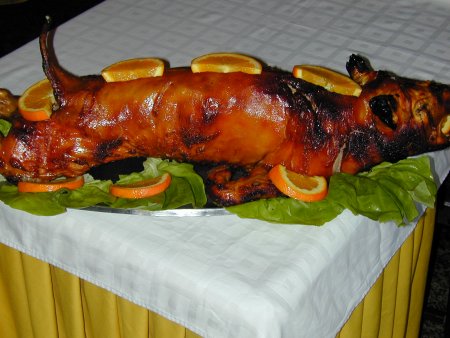

Leitão da Bairrada (4)
For 12 persons / para 12 pessoas
  • 1 piglet / 1 leitão (3kg depois de limpo) 
  • 100 g of lard / 100 gr de banha 
  • 100 g of bacon / 100 gr de toucinho 
  • 10 cloves of garlic / 10 dentes de alho 
  • 2 soupspoons of coarse salt / 2 colheres (sopa) de sal grosso 
  • 2 soupspoons of pepper / 2 colheres (sopa) de pimenta do reino 
  • 3 bay leaves / 3 folhas de louro 
  • olive oil / azeite de oliva 
  • dry white wine / Vinho branco seco 
  • chopped parsley / salsinha picada 
  • salt / sal 
  • 2½ kg of young potatoes cooked with peel / 2½ kg de batatas novas pré-cozidas com casca
Mash in a mortar, in order: garlic, salt, pepper, parsley, bacon, lard and bay until thoroughly full. Add olive oil until a piglet is not very thick.
With a thick needle pierce piglet's back and shoulders. Pass the spice in piglet, greasing well both inside and outside. Sew the belly.
Bake slowly in a wood burning oven basting from time to time, with white wine.
Halfway through the cooking place the potatoes, peeled, on broiler.
When it's baked, remove the accumulated sauce.

---
Amasse em um almofariz, por ordem: alho, sal, pimenta, salsinha, toucinho, banha e louro até estarem totalmente desfeitos. Adicione azeite de oliva até obter uma papa não muito grossa.
Com uma agulha grossa fure as costas e as espáduas do leitão. Passe o tempero no leitão, untando bem por dentro e por fora. Costure a barriga.
Asse, lentamente, em forno à lenha regando, de vez em quando, com vinho branco.
Na metade do cozimento coloque as batatas, sem casca, na assadeira.
Quando estiver assado, retire o molho acumulado no ventre.

Saturday, February 2, 2013

Sardinha assada

As Portugal is a country next to the Atlantic ocean then obviously fish is important part of traditional cuisine. In addition to codfish, Portuguese also love sardines (1).
Grilled sardines are very typical for the Setúbal region in Southern Portugal and they are also considered as one of the 7 Wonders of Gastronomy in Portugal (2).
Since the sixteenth century the importance of sardines was recognized in the Iberian Peninsula. Judge Duarte Nunes Lion mentions sardines of Setúbal and Sesibra waters in "Census of Lusitanian coastal fish" as the most tasty sardines that you can get (3).
Setúbal is nowadays also the main place where Portuguese fish sardines. On the 15th January 2010 it was the first fishery in the Iberian Peninsula and in the European Union to get the blue label with good sustainability certification and management of fishery resources MSC ("Marine Stewardship Council") (3). Setúbal is also known for sardinhas assadas. Pull the coal to its sardines, is a very popular expression used in Portugal, which means defending our interests, and that has its origin in making the dish itself. The way you put the sardines with their bellies into over the coals in a position head / tail, and how we fueling and burning coal, baking sardines over low heat, turning the double grid, implying that pulls sardines in our direction. To best enjoy sardines, it should be eaten on top of the bread, which absorbs the natural fat, can then be roasted in the coals (3).

---
Portugal é um país ao lado do oceano Atlântico, obviamente, o peixe é parte importante da cozinha tradicional. Além de bacalhau, os portugueses também adoram sardinhas (1).
Sardinhas assadas são muito típicas da região de Setúbal no Sul de Portugal e são considerados como uma das 7 Maravilhas da Gastronomia de Portugal (2).
Desde o século XVI, a importância de sardinhas foi reconhecido na Península Ibérica. Juiz Duarte Nunes do Leão menciona sardinha de Setúbal e Sesimbra em "Recenseamento de peixes do litoral lusitano", como as sardinhas mais saborosas que se pode obter (3).
Setúbal é hoje também o principal lugar onde há as sardinhas portuguesas. A 15 de Janeiro de 2010, a sardinha portuguesa, de onde se destaca a que é pescada em Setúbal, foi o primeiro pescado na Península Ibérica e na União Europeia a obter o rótulo azul com a certificação de sustentabilidade e boa gestão dos recursos piscatórios MSC ("Marine Stewardship Council") (3). Setúbal também é conhecido por sardinhas assadas. Puxar a brasa à sua sardinha, é uma expressão popular muito utilizada em Portugal, que significa defender os nossos interesses pessoais, e que tem a sua origem na confeção do prato em si. A forma como se coloca as sardinhas com as barrigas para dentro em cima da brasa, numa posição cabeça/rabo, e a forma como se ateia e queima o carvão, assando a sardinha em lume brando, dando a volta na grelha dupla, dando a entender que se puxa a sardinha na nossa direcção. Para melhor saborear a sardinha, esta deverá ser comida em cima do pão, que absorvendo a gordura natural, poderá depois ser tostado nas brasas (3).

Sardinha assada (4)
  • sardines / sardinhas
  • salt / sal grosso q.b.
Before grilling sardines place them in a colander and sprinkle them with plenty of salt.
Prepare the coals of your grill and heat the grill well (it is important that the sardines are not glued to the grid), placing it at a distance of about 5 cm from the coals.
Shake or if you prefer sardines pass by running water (inside scoop) and arrange them on the grill. Grill them well on both sides (depending on the coals of your grill + / - 3 minutes per side).
Remove the sardines to a platter and accompany with cornbread, salad and peppers.

---
Antes de assar as sardinhas coloque-as num recipiente com escorredor e salpique-as abundantemente com sal grosso.
Prepare as brasas do seu grelhador e aqueça bem a grelha (é importante para que as sardinhas não fiquem coladas à grelha), colocando-a a uma distância de cerca de 5 cm das brasas.
Sacuda ou se preferir passe as sardinhas por água corrente (dentro do escorredor) e disponha-as na grelha. Asse-as bem dos dois lados (dependendo das brasas do seu grelhador +/- 3 minutos de cada lado).
Retire as sardinhas para uma travessa e acompanhe com broa de milho e salada de pimentos.

5. Recipe

Friday, January 11, 2013

Chanfana

So, the Christmas holidays are over and I am back here to share my discoveries about Portuguese cuisine. I have never tried the dish that I am going to talk about - chanfana -, but I liked the story behind it. Well, actually stories, in plural, because it turns out that the origin of the dish is not so clear. Anyway, Portugal has recently voted on its Seven Gastronomical Wonders and chanfana was shortlisted for the best meat dish category (although finally beaten by leitão - suckling pig) (1). I think it's quite trustworthy guarantee that the dish is worth trying.
Chanfana (the Portuguese Goat roast/stew) is a traditional dish in the center of Portugal, Beira Litoral Province. Although the chanfana is also well-known in Coimbra, the capital of the province, the actual birth place of this dish is in Vila Nova de Poiares - if the legends are correct (2). However, the dish is even so important in this region that every April a festival called "Capital of chanfana" is organized in Miranda do Corvo. The goal of the festival is to draw attention to local traditions and gastronomy and the way how to preserve it (3).
In the original recipe is used goat meat, but nonetheless, there are certain places in the Beira Litoral Province that use billy-goat, instead, such as – for instance – Coimbra. And then it didn’t take long for people to replace the goat for mutton, lamb, goatling or whatever suited their fancy, so nowadays you can actually find chanfana of about any kind of meat you can think of (2). In Miranda do Corvo there are two unique dishes derived from chanfana: a sopa de casamento and negalho. Although chanfana is typical for several municipalities in the Beira Litoral, a sopa de casamento and negalho are only made ​​in Miranda de Corvo. For a sopa de casamento are used leftovers of chanfana and for negalho goat entrails that are not used for making chanfana (1).
The story of the chanfana dish got tangled with the French Invasions during the Napoleonic campaigns in Europe in the 19th Century, so the versions of the story shift, although the basis remain basically the same. In August 1810 the French Troops invaded Portugal, pushing the English and Portuguese troops all the way to Buçaco, in the Beira Litoral Province. Eventually they pushed the troops south, remaining in the Central Region for about 3 years. During that time, as it was normal back then, they pillaged the surrounding areas, taking everything they could find, that included the animals, but they left behind the old goats and billy-goats, because they found they weren’t good to eat, since it was tough meat. So, the most common version says that the Portuguese people had to make due with what they left, the old animals and they found a way to cook it, so that it would taste better and also the meat was tender. For that they used red wine, lots of it (2).
But another version tells that was not what happened. What happened was that there a Monastery in Semide, which is part of Vila Nova de Poiares in Miranda do Corvo, where the nuns displeased with the state of things, invasions and invaders and pillages and the likes, decided to kill all the animals they had and cook them, so the French couldn’t have them. And apparently according to this version, all the animals they had were old goats, by the looks of it. But here is where the stories differ: by one account, the Frenchmen, to get back at the population or the nuns, had poisoned the waters, so the nuns had no water to cook; another account mentions, that actually who poisoned the waters were the nuns, so the Frenchmen had no water. No matter which version is accurate, the matter is that they didn’t have water to cook, so instead they used red wine (2).
Finally, a more peaceful version of the events leaves out the Frenchmen and just mentions that actually the farmers and shepherds around the Monastery had to pay a rent each year. Many of them paid the rent in kind, depending on what they had, so a lot of them had wine, so they paid in wine, others had goats and so on and so forth. Now, the nuns didn’t have the time or the expertise to keep a large herd, so they found a way to cook the meat in a manner that actually preserved the meat for a long time. Once the goat was cooked, the nuns stored the meat in its original cooking recipients in the fresh cellars of the monastery. The roasted/stewed goat meat cooked in the red wine was preserved in the solified gravy from the cooking for several months (2).
One more interesting fact about chanfana is that it's not cooked in ordinary pan or pot, traditionally the black clay pot from Olho Marinho in Vila Nova de Poiares is used for that. Of course this pot is not obligatory for making chanfana but it is said that the dish tastes much better if you use it (2).

Saturday, December 15, 2012

Christmas dishes / Pratos de Natal

I just realized that after 10 days it's Christmas! For me it's quite hard to believe it because you know, I come from Northern Europe where good Christmas are with snow. Here, in Portugal, everything is green (better than in summer I would say), we pick oranges from our trees and sometimes when it's sunny, it's possible to be outside just with a T-shirt!
Anyway, this time I introduce very briefly typical Portuguese Christmas dishes, including main course, desserts and also drinks.

---
Eu só percebi que após 10 dias é Natal! Para mim é muito difícil de acreditar, porque você sabe, eu venho do norte da Europa onde boas Natal são com neve. Aqui, em Portugal, tudo é verde (melhor do que no verão eu diria), nós escolhemos laranjas em nossas árvores e, por vezes, quando está sol, é possível estar fora apenas com uma t-shirt!
De qualquer forma, desta vez eu introduzo brevemente pratos típicos portugueses de Natal, incluindo prato principais, sobremesas e bebidas também.


Main courses / pratos principais
  • bacalhau – codfish in every form (for example bacalhau com natas)
  • polvo cozido - boiled octopus
  • Perú Recheado com Nozes - turkey stuffed with walnuts
  • borrego assado - roasted lamb
  • cabrito assado - roasted goat
Desserts / sobremesas
  • Bolo Rei (King Cake) - a beautifully decorated fluffy fruitcake
  • Bolo-Rei Escangalhado (Broken King Cake)- it is like the first one, but has also cinnamon and chilacayote jam (doce de gila)
  • Bolo-Rei de Chocolate (Chocolate King Cake) - it is like the King Cake, but only has chilacayote jam, nuts, raisins and less (or no) fruit, which is replaced by lots of chocolate chips
  • Bolo-Rainha (Queen Cake) - similar to Bolo-Rei, but with only nuts, raisins and almonds
  • Bolo-Rei de Chocolate - it is like the Bolo-Rei, but has less (or no) fruit, nuts, chilacayote jam and lots of chocolate chips
  • broa castelar - a small, soft and thin cake made of sweet potato and orange
  • fatias douradas - golden slices, known as french toast - slices of pan bread, soaked in egg with sugar, fried and sprinkled with powdered sugar and cinnamon
  • rabanadas - they are like fatias douradas, but made with common bread
  • formigos - a delicious dessert made with sugar, eggs, pieces of bread, almonds, port wine and powdered with cinnamon
  • filhoses - depending on the region, the may be thin or fluffy pieces of a fried dough made of eggs, honey, orange, lemon, flour and anise, sprinkled - or not with icing sugar
  • coscorões - thin squares of a fried orange flavoured dough
  • azevias de grão, batata-doce ou gila - deep fried thin dough pastries filled with a delicious cream made of chickpea, sweet potato or chilacayote, powdered with sugar and cinnamon
  • tarte de amêndoa - almond pie
  • tronco de Natal - Christmas log - a delicious Swiss roll, resembling a tree's trunk, filled with chocolate cream, decorated with chocolate and mini - 2 cm Christmas trees
  • lampreia de ovos - a sweet made of eggs, well decorated
  • sonhos - an orange flavoured fried yeast dough, powdered with icing sugar
  • velhoses - they are like the sonhos, but made with pumpkin
  • bolo de Natal - Christmas cake
  • pudim de Natal - Christmas pudding, similar to flan
  • Massa de Filhos A Christmas doughnut traditionally left to rise whilst the family attend Midnight mass
  • Leite Creme - a creamy Christmas dessert
  • sopa dourada - Golden Soup – which is actually a dessert not a soup.
  • mexidos - another dessert from the North of Portugal. This looks very simple to make!
  • arroz doce - sweet rice pudding – yes, a favourite at Christmas time too.
Drinks
  • vinho quente - eggnog made with boiled wine, egg yolk, sugar and cinnamon
  • just a lot of wine
---

Cabrito assado
Cabrito assado (3a)

For 6-8 persons / para 6-8 pessoas
  • 1,5 kg of kid goat / 1,5 kg de cabrito
  • 1 big tablespoon of ground pepper / 1 colher de sopa bem cheia de massa de pimentão
  • 4 cloves of garlic / 4 dentes de alho picados
  • 3 bay leaves / 3 folhas de louro
  • 1 onion cut to half moons / 1 cebola cortada em rodelas meia-lua
  • sprigs of parsley / raminhos de salsa
  • 500 ml of white wine / 500 ml de vinho branco
  • salt / sal q.b.
  • pepper / pimenta q.b.
  • 1 kg of potatoes for roasting / 1 kg de batatinhas para assar
  • 30 ml of olive oil / 30 ml de azeite
  • 2 tablespoons of lard / 2 colheres de sopa de banha
  • 200 ml of broth / 200 ml de caldo de carne

Flavor the goat in a bowl with salt, pepper, garlic and ground pepper. Mix it all. Add the bat leaves, onion, and sprigs of parsley. Drizzle it all with white wine and store it in fridge for one day.
The next day, flavor potatoes with salt, pepper and half of olive oil. Mix it all.
In a baking tray, place to the bottom sprigs of parsley, onion and bay leaves. To the top put the meat and spread the potatoes around the meat. Drizzle everything with the marinade of the meat, broth and the rest of olive oil. To the top scatter the bits of lard.
Leave it to the oven with 200º during 1 hour and 10 minutes. In the middle, turn the meat to be roasted from both sides.
When the goat is roasted, add greens and serve.

---
Numa tigela, tempere o cabrito com sal, pimenta, os alhos picados e a massa de pimentão. Misture tudo. Junte as folhas de louro, as rodelas de cebola e os raminhos de salsa. Regue tudo com o vinho branco e guarde no frigorífico de um dia para o outro.
No dia seguinte, tempere as batatas com sal, pimenta e metade do azeite. Misture tudo.
Num tabuleiro de ir ao forno, coloque no fundo os raminhos de salsa, a cebola e as folhas de louro. Por cima, coloque a carne e à volta da carne espalhe as batatas. Regue tudo com o marinado da carne, o caldo de carne e o restante azeite. Por cima, espalhe pedacinhos de banha.
Leve ao forno pré-aquecidos nos 200º durante 1 hora e 10 minutos.
A meio do tempo, vire a carne para ficar loira de ambos os lados.
Depois do cabrito assado, acompanhe com grelos e sirva.


Sonhos
Sonhos (4a)
About 20 sonhos / mais ou menos 20 sonhos
  • 125 ml of water / 125 ml de água
  • 125 ml of milk / 125 ml de leite
  • 50 g of margarine / 50g de margarina
  • 1 lemon peel / uma casca de limão
  • pinch of salt / uma pitada de sal
  • 150 g of flour / 150g de farinha
  • 4 eggs / 4 ovos
  • oil for frying / óleo para fritar
  • sugar / açúcar q.b.
  • ground cinnamon / Canela em pó q.b.

Put the water with milk, lemon peel, salt and margarine to the fire. Let it boil. When it starts boiling, take it from the fire, add the flour at once and stir well until it forms a ball that peel off the bottom of the pan. After the dough ball formed, place in a bowl, remove the lemon zest and let it cool slightly.
Add the eggs one by one and mix it very well with wooden spoon between each addition. Mix it until the mass is homogeneous.
With two spoons, form the balls of the mass, not very big because their volume will triple. Fry the balls in hot oil, keeping the fire all the time mild. Pike the sonhos at times with fork or toothpick. Fry them until their size has tripled and they are golden. After frying, put them to the absorbent paper.
Meanwhile mix the sugar with cinnamon as you like. After frying roll the balls in mixture of sugar and cinnamon and put them to the plate.

---
Num tacho, leve ao lume a água, o leite, a casca de limão, a pitada de sal e a margarina.
Deixe ferver. Logo que comece a ferver, junte a farinha de uma só vez e mexa muito bem até formar uma bola que descole do fundo do tacho. Depois da bola de massa formada, coloque numa tigela, retire a casca de limão e deixe arrefecer um pouco.
Junte os ovos um a um e mexa muito bem com a colher de pau entre cada adição.
Mexa até a massa ficar homogênea.
Com a ajuda de duas colheres, faça bolas de massa, não muito grandes pois o seu volume irá triplicar. Frite em óleo quente, mantendo sempre o lume brando. Pique os sonhos de vez em quando com um garfo ou palito. Deixe fritar até triplicarem de tamanho e ficarem loirinhos. Depois de fritos, retire-os para um prato com papel absorvente.
Entretanto misture o açúcar com a canela a gosto. Depois de fritos passe os sonhos pela mistura do açúcar e canela e coloque-os num prato de bolo.


Vinho quente
Vinho quente (5a)
For 6 persons  / para 6 pessoas
  • 6 eggs / 6 ovos
  • 1 litre of water / 1 l de água
  • 250 g of sugar / 250 g de açúcar
  • 2,5 dl red green wine / 2,5 dl de vinho verde tinto
  • 2,5 dl red Madeira wine or Moscatel / 2,5 dl de vinho Madeira tinto ou Moscatel
  • 2,5 dl Porto wine (red and sweet) / 2,5 dl de vinho do Porto (tinto doce)
  • crusty bread / pão duro
  • salt / sal

Beat the egg yolks with sugar until they obtain a good eggnog. Meanwhile, put water with a little bit salt to the fire. Let it boil. Then remove it from the fire, add the green wine and Madeira wine (or moscatel) and put it again to the fire to boil.
After that, add the liquid little by little to the eggs. Put it again to the fire and boil it. The eggs will be well cooked. Take it from the fire, add the Porto wine. Mix it and if necessary add a little bit more sugar. 
At the time of serving, heat the wine in a water bath and serve in the cups with small pieces of bread.

---
Batem-se as gemas com açúcar até se obter uma boagemada. Entretanto, leva-se ao lume 1 l de água a que se juntam umas pedrinhas de sal. Deixa-se levantar fervura. Retira-se do calor, juntam-se os vinhos verde
e Madeira (ou moscatel) e leva-se novamente ao lume para levantar fervura.
Depois, adiciona-se o líquido, a pouco e pouco, à gemada. Volta a ir ao lume apenas para ferver. Os ovos ficaram assim cozidos. Fora do calor, adiciona-se o vinho do Porto que já não vai ao lume. Mexe-se e, se for necessário, junta-se um pouco mais de açúcar. 
Na altura de servir, aquece-se o vinho em banho-maria e serve-se em chávenas com bocadinhos de pão fazendo sopas.


Friday, November 23, 2012

Cozido à portuguesa

While living in a small Portuguese village, I hear really often the sentence "Portuguese people love meat!" Well, I don't know very much about the life in bigger cities in Portugal, but I can say that here it is 100% true, meat is at least as important as bacalhau
Eating meat and poultry on a daily basis was historically a privilege of the upper classes. Meat was a staple at a nobleman's table during the Middle Ages. A Portuguese Renaissance chronicler, Garcia de Resende, describes how an entrée at a royal banquet was composed of a whole roasted ox garnished with a circle of chickens (1).
A common Portuguese meat dish, mainly eaten in winter, is cozido à portuguesa. It is originated in the Beira region and although the form of preparation and the ingredients vary a little bit from region to region, it is popular in all Portugal (2). Cozida à portuguesa is a rich stew that usually includes shin of beef, pork and Portuguese sausages (morcela, farinheira and chouriço) and in some regions also chicken. It is served with cabbage, carrots, turnips, rice, potatoes and collard greens (3). However, its composition depends on the cook's imagination and budget (1). Cozida à portuguesa is often served with olive oil and red wine (3). 
The history of this dish is quite simple: there was a poor man who didn't have much money. To have some energy for a cold winter day he put all his leftovers to the pan and cooked it (4). So, it has originally been a favorite food of the affluent farmer, which later despite of its simplicity reached the tables of the urban bourgeoisie and typical restaurants (1). In fact, it is also loved in Spain and is a prominent part of Spanish diet (5).

---

Enquanto vivo numa pequena aldeia Portuguesa, ouço muito frequentemente a frase "os portugueses adoram carne!" Bem, não sei muito sobre a vida nas grandes cidades em Portugal, mas posso dizer que aqui é 100% verdade, a carne é pelo menos tão importante como o bacalhau.
Comer carne e frango em uma base diária foi historicamente um privilégio das classes elevadas. A carne era essencial na mesa de um nobre durante a Idade Média. O cronista Português, Garcia de Resende, descreve como as entradas em um banquete real eram compostas por um boi inteiro assado guarnecido com um círculo de galinhas (1).
Um prato de carne comum Português, principalmente comido no inverno, é o cozido à portuguesa. É originária da região da Beira e embora a forma de preparar e a combinação de ingredientes variem um pouco de região para região, é possível encontrar por todo o Portugal (2). Cozida à portuguesa é um guisado rico que geralmente inclui canela de vaca, carne de porco, salsichas portuguesas (morcela, farinheira e chouriço) e em algumas regiões frango também. É servido com caldo, cenoura, nabo, arroz, batatas e couve (3). No entanto, a sua composição depende da imaginação do cozinheiro e do orçamento (1). Cozida à portuguesa é frequentemente servido com azeite de oliva e vinho tinto (3).
A história deste prato é bastante simples: havia um homem pobre que não tinha muito dinheiro. Para ter um pouco de energia para um dia frio de inverno, ele colocou todas as suas sobras para a panela e cozinhou (4). Assim, tem sido originalmente uma comida favorita do agricultor afluente, que mais tarde, apesar de sua simplicidade chegou às mesas da burguesia urbana e restaurantes típicos (1). De facto, também é apreciado em Espanha e é um importante componente na dieta Espanhola (5).


Cozida à portuguesa (6)
  • Beef, adequate for cooking / carne de vaca, adequada para cozer
  • half a chicken / meia galinha
  • 1 pork foot, entrecote, chispe / 1 pé de porco, entrecosto, chispe
  • portuguese sausages: presunto, chouriço, farinheira, salpicão; 
  • salted bacon, bacon / toucinho salgado, bacon 
  • fresh and smoked pork ear / orelheira fresca e fumada; 
  • portuguese cabbage (kale) / couve portuguesa (penca) 
  • carrots, potatoes, turnips / cenouras, batatas, nabos; 
  • salt and olive oil / sal e azeite q.b.

Start with cooking all the meat in big pot. The meat that is saltier has to stay in liquid for some hours before cooking.
Drizzle the cooking water with olive oil and flavor it as you like. To make cooking faster, you can remove sausages after a while, then the pork and in the end the beef when it's well cooked.
After taking meat out use the same water for cooking vegetables. When they are cooked, remove the pot from the fire, leaving the vegetables inside.
For serving, cut the meat and put them to the plate with vegetables. You can also add white beans (cooked with other vegetables) and white rice.

---
Comece por cozer todas as carnes numa panela grande. As carnes que forem mais salgadas devem ficar de molho préviamente umas horas e só depois se colocam a cozer.
Regue a água da cozedura com um fio de azeite e tempere a gosto. Por ordem de cozedura mais rápida, vão-se tirando os enchidos, depois as carnes de porco, e só no fim é que se retira a carne de vaca depois de bem cozida.
Aproveitando a mesma água de cozer as carnes, coloque os legumes. Quando estes estiverem cozidos, retire a panela do lume, deixando os legumes dentro.
Para servir, corte as carnes, disponha numa travessa com os respectivos legumes. Pode acompanhar com feijão branco cozido, também cozido na água dos legumes, e arroz branco.

7. Recipe 

Saturday, November 10, 2012

Bacalhau com natas

The name of the blog - The Land of Bacalhau - already shows that bacalhau (or codfish in English) is very important part of Portuguese cuisine and therefore it's good to start sharing my discoveries about Portuguese cuisine with it. I have to mention that usually Portuguese people mean by bacalhau dried and salted codfish and fresh (unsalted) codfish is referred to  as bacalhau fresco. (1). I think I have never seen fresh bacalhau here, they just don't consume it like this!
Mostly Portugal imports bacalhau from Norway. The Portuguese tried to use the method of drying and salting on several varieties of fish from their waters, but the ideal fish came from much further north. With the "discovery" of Newfoundland in 1497, long after the Basque whalers arrived in Channel-Port aux Basques, they started fishing its cod-rich Grand Banks. Thus, bacalhau became a staple of the Portuguese cuisine, nicknamed Fiel amigo (faithful friend). From the 18th century, the town of Kristiansund in Norway became an important place of purchasing bacalhau. (1)
In Portugal it is said that there are 365 ways how to cook bacalhau, one for every day of the year. (1) (I wonder how big the number would be, if they used also fresh codfish.) This time I chose bacalhau com natas (codfish with cream) but really, it is just a little piece of the big bacalhau world.
The origin of this dish is unclear, but a similar one using cod and cream was invented by chef João Ribeiro in the 1930s. (2)

---

O nome do blog - A Terra do Bacalhau - mostra que o bacalhau (ou codfish em Inglês) é um elemento muito importante na cozinha Portuguesa e, por isso, é importante começar a partilhar as minhas descobertas sobre a culinária Portuguesa com este assunto. O bacalhau pode encontrar-se seco e salgado ou fresco (sem sal). (1). Eu acho que eu nunca vi bacalhau fresco, os Portugueses simplesmente não o consomem assim!
Portugal importa principalmente o bacalhau da Noruega. Os Portugueses tentaram usar o método de secagem e salga em diversas variedades de peixes das suas águas, mas o peixe ideal veio do norte, de muito mais longe. Com a "descoberta" da Terra Nova em 1497, começaram a pescar bacalhau nos seus ricos e grandes bancos. Assim, o bacalhau tornou-se um marco da culinária Portuguesa, apelidado de Fiel amigo. A partir do século XVIII, a cidade de Kristiansund na Noruega tornou-se um importante local de compra de bacalhau. (1)
Em Portugal diz-se que há 365 maneiras como cozinhar bacalhau, uma para cada dia do ano. (1) (Eu pergunto-me como seria, se eles utilizassem também o bacalhau fresco.) Desta vez eu escolhi o bacalhau com natas, mas realmente, é apenas uma pequena parte do grande mundo do bacalhau.
A origem deste prato é incerta, é similar ao bacalhau com creme inventado pelo chefe João Ribeiro em 1930. (2)


Bacalhau com natas (3)
For 4 persons/para 4 pessoas:
  • 4 slices of salted codfish / 4 postas bacalhau demolhado
  • 1 kg of potatoes / 1 kg batatas
  • 1 dl olive oil / 1 dl azeite
  • 2 medium onions / 2 und. cebolas médias
  • 3 cloves garlic / 3 dentes alho
  • 40 g of flour / 40 g farinha
  • 40 g of butter / 40 g manteiga
  • 2. 50 dl of milk / 2.50 dl leite
  • 2.50 dl of cream / 2.50 dl natas
  • salt / q.b. sal
  • pepper / q.b. pimenta
  • nutmeg / q.b. noz moscada
  • lemon juice / q.b. sumo de limão
  • tea cheese or breadcrumbs / col. chá queijo ou pão ralado

Cook the cod during 3 minutes in 0.5 l of water. Remove the face and bones and cut it to small pieces. Keep the water.
Peel the potatoes, wash them, cut into small cubes and fry them in hot oil, without leaving them to get brown. After frying, drain them well and place them on absorbent paper to take the excess fat. Flavor with salt.
Cut the onions into thin half moons and roast them in olive oil with chopped garlic, until they are translucent. Add the cod, let it cook a little bit more, and after mix the potatoes and add them also.
Prepare the béchamel sauce: melt the butter in saucepan, add flour and mix it well; then add bit by bit 1 dl of water what was left from cooking the cod and all the time keep stirring; then add milk and cream and mix until it's bubbling; and finally turn off the fire and flavor with salt, pepper, nutmeg and lemon juice.
Mix 2/3 of the sauce to prepared cod and potatoes, and then put the mixture into oven form which is previously smeared with the butter. Cover the surface with the remaining sauce, put some cheese or breadcrumbs and leave it to the oven until it's golden. Serve with spinach.

---
Coza o bacalhau durante três minutos em 0,5 l de água. Retire a pele e as espinhas e parta-o em lascas pequenas. Reserve a água.
Descasque as batatas, lave-as, corte-as em pequenos cubos e frite-as em óleo quente, sem deixar alourar. Depois de fritas, escorra-as bem e coloque-as sobre papel absorvente para lhes tirar o excesso de gordura. Tempere-as com sal.
Corte as cebolas em meias luas finas e refogue-as em azeite, juntamente com alho picado, até ficarem translúcidas. Junte as lascas de bacalhau, deixe refogar mais um pouco, e misture depois as batatas e envolva-as no preparado.
Prepare um molho de béchamel: derreta a manteiga num tachinho, acrescente a farinha e mexa bem; junte, aos poucos, 1 dl de água da cozedura do bacalhau, mexendo sempre; junte depois o leite e as natas e mexa até borbulhar; e, finalmente, retire do lume e tempere com sal, pimenta, noz moscada e sumo de limão.
Misture 2/3 do béchamel na preparado de bacalhau e batatas, e, disponha a mistura num tabuleiro, previamente untado com manteiga. Cubra a superfície com o restante molho, polvilhe com queijo ou pão ralado e leve ao forno até alourar bem. Sirva com esparregado. (4)